 Abrir en Preply
Present perfect and present perfect continuous
- Corrected forms: 'have/has + past participle' and 'have been + -ing' usage
- Practiced sentences: 'She has written her essay' and 'I have been painting all day'
La clase se centró en el presente perfecto y el presente perfecto continuo, y después amplió el trabajo con cláusulas relativas definitorias y explicativas. La tutora corrigió formas verbales, concordancia en presente simple y pronunciación mientras Celeste producía ejemplos y respondía preguntas.
Practicing present perfect
Con Alianna J.
In this lesson you practiced present perfect and present perfect continuous with many example sentences and reviewed relative clauses and defining/non-defining information. The tutor corrected pronunciation, verb forms, and small grammar points while you practiced speaking and answering questions throughout.
Defining relative clauses provide essential information without commas; non-defining relative clauses add extra information and are separated by commas. Examples
The present perfect tense describes actions that happened at an unspecified time or that have relevance to the present. The present perfect continuous describes actions that began in the past and continue to the present or were recently happening. Examples
Correcciones, pronunciación y práctica preparadas a partir de esta clase. No las escribió tu profesora.
Para la etapa activa A1, semana 4, el repaso prioritario de esta clase es más pequeño que el tema principal: tercera persona en presente simple (it looks), una oración frecuente sobre ubicación (my friends live in Valencia) y la pronunciación de laboratory y sparkling. El presente perfecto y las cláusulas relativas se conservan como ampliación opcional.
it, el verbo lleva -s: I think it looks a lot better.-s: My friends live in Valencia.laboratory tiene el acento principal al principio: /ˈlæbrəˌtɔri/ en inglés estadounidense.sparkling significa espumoso/a y se pronuncia /ˈspɑrklɪŋ/.I haven't done the homework yet usa presente perfecto para una acción pendiente hasta ahora.Tim Berners-Lee, who invented the web, ....No se creó una tarjeta de horarios porque la captura de esta clase no contiene un ejemplo de horario suficientemente claro. El índice A2 menciona los arreglos futuros, pero no aporta una oración practicada que justifique una tarjeta.
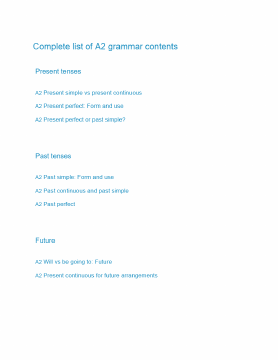
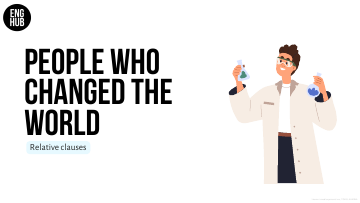
Alianna J. compartió dos PDF. B1_People_Who_Changed_The_World_-_Relative_Clauses_SV_(1).pdf es una presentación de catorce páginas con explicación, práctica oral, ejercicios y tarea sobre cláusulas relativas; Celeste anotó HW 11-12, que se conserva sin reinterpretar. Complete_list_of_A2_grammar_contents.pdf es un índice visual de seis páginas —la última está en blanco— con los puntos gramaticales A2. La tutora indicó que casi todos los tiempos A2 ya se han completado y que quedan principalmente otros puntos gramaticales.
Ambos originales se conservaron con sus checksums. El primer PDF tenía texto extraíble; el segundo no tenía capa de texto, por lo que se creó una transcripción manual searchable después de revisar visualmente todas las páginas.
To make a declaration or assurance that one will do something or that a particular thing will happen.
En tu lección
From your lesson: “How how do you pronounce promised?”
Otro ejemplo
I promise to call you when I arrive.
To compose text, such as a letter, story, or article, by putting words together.
En tu lección
From your lesson: “She has write written her essay”
Otro ejemplo
He likes to write stories in his free time.
To fall as water drops from clouds in the sky.
En tu lección
From your lesson: “It hasn't been rain raining for three hours”
Otro ejemplo
It will rain tomorrow according to the weather forecast.
Having a strong, unpleasant, or offensive odor.
En tu lección
From your lesson: “Israeli smiling, smelly, smelly. In here, how do you mean smelly?”
Otro ejemplo
The garbage can is very smelly.
A person who writes books, stories, articles, or other texts as a profession or hobby.
En tu lección
From your lesson: “They read write? Written. Writer. Writer. How do you pronounce Esso?”
Otro ejemplo
The writer published her first novel last year.
To be worthy of or have earned something, especially as a result of one's actions or qualities.
En tu lección
From your lesson: “Esso? Deserve. No. No. No. El El Verbo. Deserve.”
Otro ejemplo
She worked hard and deserve a promotion.
(Not standard) Used to describe something that has been brought to a more advanced or mature state; fully grown or evolved.
En tu lección
From your lesson: “The company the Company that develop develop better developed The first smartphone changed modern life.”
Otro ejemplo
The develop city infrastructure impressed the visitors.
The period between birth and death of a living being; the existence of an individual.
En tu lección
From your lesson: “The people who fight for human, right, often risk their life lives.”
Otro ejemplo
He lived a long and happy life.
In a very short period of time; almost at once.
En tu lección
From your lesson: “And the technology that that helps people communicate instant instantly.”
Otro ejemplo
The news spread instantly across social media.
A room or building equipped for scientific experiments, research, or teaching, especially in natural sciences such as chemistry, biology, or physics.
En tu lección
From your lesson: “The place where important scientific disc disco scientific discovery discoveries are made is often a lab laboratory.”
Otro ejemplo
The students conducted experiments in the laboratory.
A person who is trained in and works in one or more of the natural or physical sciences, such as biology, chemistry, or physics.
En tu lección
From your lesson: “Science science, Sarah? Scientist.”
Otro ejemplo
Marie Curie was a famous scientist.
A story, excuse, or idea that is made up and not true; fabrication.
En tu lección
From your lesson: “Eight at the invasion invasion? Invention.”
Otro ejemplo
His explanation was pure invention.
To fill someone with the urge or ability to do or feel something, especially something creative or positive.
En tu lección
From your lesson: “The woman who wrote a book inspired inspired people around the world.”
Otro ejemplo
Her speech will inspire many young people to follow their dreams.
The presence or introduction of harmful substances or products into the environment, especially air, water, or soil, causing adverse effects.
En tu lección
From your lesson: “The engineer designed a new system for those are k. Reduce eye air pollution.”
Otro ejemplo
The city is taking steps to reduce air pollution.
To have an effect on the way someone thinks, behaves, or develops.
En tu lección
From your lesson: “The writer whose ideas influence modern society published a novel.”
Otro ejemplo
Her speech will influence many young people.
Las cifras de esta clase, comparadas con todas tus lecciones.
Vocabulario acumulado
1.522 palabras +108 respecto de la clase anterior
Palabras nuevas
108 palabras +56 respecto de la clase anterior
Palabras habladas
1.056 palabras +337 respecto de la clase anterior
Variedad de vocabulario
19 puntos
Ritmo al hablar
54 palabras/min −9 respecto de la clase anterior
Tiempo hablando
24 min +1 respecto de la clase anterior
55% del tiempo de conversación
Feedback and examples use American English. More accents coming soon.
Laboratory.
Tu pronunciación · 0,9 s
Pronunciación de ejemplo · 1,1 s
Sparkling.
Tu pronunciación · 1,3 s
Pronunciación de ejemplo · 1 s
Scientist.
Tu pronunciación · 0,8 s
Pronunciación de ejemplo · 1 s
The technology whose ...
Tu pronunciación · 2 s
Pronunciación de ejemplo · 1,1 s
Dijiste
...They have been studying very hard recently.
Fantastic! Your use of the present perfect continuous shows a great understanding of ongoing actions.
Dijiste
...How do you pronounce promised?
Well done! Your verb form is correct and natural for asking about pronunciation.
Dijiste
...Because my friends live in Valencia.
Perfect! Your use of 'in' for location is absolutely correct.
Dijiste
...The woman who wrote a book inspired people around the world.
Excellent use of the relative pronoun 'who'! You're connecting ideas smoothly.
Dijiste
...I'm really angry with him.
Perfect! Your choice of preposition is spot on, showing clear and natural English.
Dijiste
...But you don't say you don't save me other material.
Una alternativa
But you didn't tell me you didn't save the other material.
Replaced informal "say" with "tell," corrected tense to simple past and added "the" for clarity.
Dijiste
...I think it's look a lot better.
Una alternativa
I think it looks a lot better.
Corrected verb form from "look" to "looks" to match subject "it."
Dijiste
...It hasn't been raining for three hours, only about one hour.
Una alternativa
It hasn't been raining for three hours — it's only been about an hour.
Clarified the contradiction by splitting into two clauses and corrected "one hour" to "an hour."
Dijiste...How much petrol has she bought?
ProbáHow much petrol has she purchased?
You used the word 'bought' in this sentence. Consider using 'purchased' to enrich your active vocabulary!
Dijiste...I think it's Maria, blah blah.
ProbáI believe it's Maria, blah blah.
You used the word 'think' in this sentence. Consider using 'believe' to enrich your active vocabulary!
Dijiste...Who invented the worldwide web?
ProbáWho created the worldwide web?
You used the word 'invented' in this sentence. Consider using 'created' to enrich your active vocabulary!
Respuesta
I think it looks a lot better.
Respuesta
My friends live in Valencia.
Respuesta
laboratory
Respuesta
Sparkling water, please.
Respuesta
I haven't done the homework yet.
Respuesta
Tim Berners-Lee, who invented the web, made information available to everyone.
6 tarjetas para escribir en inglés, letra por letra.
12 tarjetas con audio.