 Abrir en Preply
Zero conditionals about facts and habits
- Practiced sentences about habits: "If you smoke, you get yellow fingers"
- Corrected verb forms and repetition for clearer pronunciation
- Linked causes and results: food, sweets, ice melting examples
Celeste practicó el condicional cero para hechos y hábitos y el primer condicional para planes, advertencias y consecuencias posibles. La clase incluyó situaciones de salud, clima y vida diaria, además de una breve práctica de planes futuros.
Practising conditional sentences
Con Alianna J.
In this lesson you practised many conditional sentences (zero and first) using everyday situations and future plans. The tutor corrected sentence forms and pronunciation while you built confidence making ‘if’ sentences about health, weather, habits and plans.
The first conditional expresses possible future events. It uses 'If' + present simple verb, followed by 'will' + base verb in the main clause. Ejemplos
Correcciones, pronunciación y práctica preparadas a partir de esta clase. No las escribió tu profesora.
She'll get heatstroke if she doesn't wear a hat.: se corrigieron las palabras confundidas y se usó will para una consecuencia futura posible.People gain weight if they eat too many sweets.: el condicional cero expresa una relación general de causa y resultado.If my daughter works hard, she'll pass her exam.: después de if se usa presente simple; will aparece en el resultado.If my flatmate cleans the house, she does it really well.: does concuerda con she y evita repetir el verbo principal.Preply destacó electricity, overweight, daughter y children. La prioridad de repaso es daughter /ˈdɔtɚ/, que obtuvo la puntuación más baja; children ya tiene una tarjeta en la clase anterior y no se duplicó.
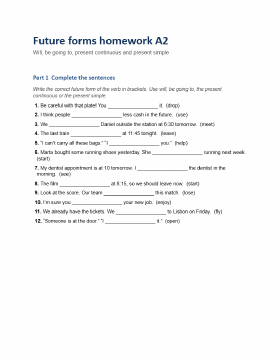
If the weather doesn't improve, we won't have a picnic.I will send, I am looking forward to y vocabulario relacionado con Oktoberfest.Future_Forms_A2_Homework.pdf, una tarea de tres páginas sobre will, be going to, presente continuo y presente simple. El original se conservó, se inspeccionó visualmente y tiene una transcripción buscable; el PDF era una imagen sin texto incrustado.La fecha corresponde a la semana 5 del plan activo. El condicional cero, el primer condicional y las formas de futuro se conservan porque forman parte de la clase verificada, pero se tratan como ampliación opcional frente al núcleo semanal de presente simple y do/does.
The physical phenomenon associated with the movement and interaction of electric charges, including static electricity and electromagnetic fields.
En tu lección
From your lesson: “But if you mix water and electric electricity, you get a shock.”
Otro ejemplo
Static electricity can make your hair stand up.
To make something warm or hot by raising its temperature.
En tu lección
From your lesson: “If you had heat ice, it melts.”
Otro ejemplo
Please heat the soup before serving it.
Affected or injured by exposure to the sun, especially suffering from heat or sunstroke.
En tu lección
From your lesson: “Julie gets sunstruck if she doesn't wear a hat.”
Otro ejemplo
After hiking all day without a hat, he became sunstruck and needed to rest.
Weighing more than what is considered healthy or normal for a particular height or age.
En tu lección
From your lesson: “If children play outside, they don't get overweight.”
Otro ejemplo
The doctor told him he was overweight and needed to exercise more.
To make something better or to become better in quality, condition, or value.
En tu lección
From your lesson: “If the water doesn't improve, we won't have a picnic.”
Otro ejemplo
She wants to improve her English skills.
Costing a lot of money; having a high price.
En tu lección
From your lesson: “If she goes shopping, she buys expensive clothes.”
Otro ejemplo
The car is very expensive.
A flat, rectangular container, typically with a handle, used for carrying papers, documents, or laptops, especially by business people.
En tu lección
From your lesson: “A briefcase person.”
Otro ejemplo
He carried his laptop in a black briefcase.
To ride a bicycle or similar vehicle.
En tu lección
From your lesson: “If the weather is fine, I cycle to work.”
Otro ejemplo
I cycle to work every morning.
A disturbance or sudden impact that causes physical jarring or vibration.
En tu lección
From your lesson: “But if you mix water and electricity, you get a shock.”
Otro ejemplo
The shock from the explosion shattered the windows.
Las cifras de esta clase, comparadas con todas tus lecciones.
Vocabulario acumulado
1.642 palabras +45 respecto de la clase anterior
Palabras nuevas
45 palabras −30 respecto de la clase anterior
Palabras habladas
849 palabras +183 respecto de la clase anterior
Variedad de vocabulario
18 puntos −5 respecto de la clase anterior
Ritmo al hablar
67 palabras/min +25 respecto de la clase anterior
Tiempo hablando
20 min −3 respecto de la clase anterior
48% del tiempo de conversación
Los comentarios y ejemplos están en inglés estadounidense. Próximamente añadiremos más variantes.
... electric electricity, you ...
Tu pronunciación · 0,9 s
Pronunciación de ejemplo · 1,1 s
... get overweight overweight.
Tu pronunciación · 1,2 s
Pronunciación de ejemplo · 0,9 s
... my daughter works ...
Tu pronunciación · 0,9 s
Pronunciación de ejemplo · 0,8 s
If children play ...
Tu pronunciación · 1,1 s
Pronunciación de ejemplo · 0,9 s
Dijiste
...If I don't go to bed early, I will be tired tomorrow.
Excellent use of 'will be' to express a future consequence!
Dijiste
...If Jenny has a party, lots of people come.
Perfect subject-verb agreement with 'Jenny has'!
Dijiste
...if you mix water and electricity, you get a shock.
Great job with the correct verb form in this zero conditional sentence!
Dijiste
...If you smoke, you get yellow fingers.
Fantastic use of the plural noun 'fingers'!
Dijiste
...If I am in a new city, I like to visit the museums.
Excellent use of the preposition 'in' for location!
Dijiste
...If she does soundstroke, if she doesn't wear a hit.
Una alternativa
She'll get heatstroke if she doesn't wear a hat.
Replaced incorrect words ("soundstroke","hit") with correct nouns, adjusted tense for a likely future warning.
Dijiste
...If the water don't improve, it doesn't.
Una alternativa
If the weather doesn't improve, it won't.
Corrected subject ("water"→"weather"), fixed subject-verb agreement and made the result clause clear.
Dijiste
...People head up fat if they eat too many sweets.
Una alternativa
People gain weight if they eat too many sweets.
Replaced non-idiomatic phrase with the natural expression "gain weight."
Dijiste
...If my daughter works hard, she passes her exam.
Una alternativa
If my daughter works hard, she'll pass her exam.
Changed simple present to future conditional to match intended meaning; sounds more natural.
Dijiste
...Cycle If flatmate cleans the house, she is really well.
Una alternativa
If my flatmate cleans the house, she does it really well.
Removed stray word, clarified action with correct verb phrase ("does it really well").
Dijiste...If it rains a lot, everybody's grumpy.
ProbáIf it rains a lot, everybody's irritable.
Has utilizado la palabra 'grumpy' en esta frase. ¡Considera la posibilidad de utilizar el término 'irritable' para enriquecer tu vocabulario!
Dijiste...If we eat all this cake, we will feel sick.
ProbáIf we eat all this cake, we will feel ill.
Has utilizado la palabra 'sick' en esta frase. ¡Considera la posibilidad de utilizar el término 'ill' para enriquecer tu vocabulario!
Dijiste...If she gets a job, he doesn't.
ProbáIf she secures a job, he doesn't.
Has utilizado la palabra 'gets' en esta frase. ¡Considera la posibilidad de utilizar el término 'secures' para enriquecer tu vocabulario!
Respuesta
She'll get heatstroke if she doesn't wear a hat.
Respuesta
People gain weight if they eat too many sweets.
Respuesta
If my daughter works hard, she'll pass her exam.
Respuesta
daughter
4 tarjetas para escribir en inglés, letra por letra.
8 tarjetas con audio.