 Abrir en Preply
Object pronouns with two objects
- Practiced replacing direct and indirect objects: I gave it to him.
- Corrected word order and pronoun placement in two-object sentences.
- Used examples: show the ticket to your mother → show it to her.
Se practicó cómo reemplazar personas y cosas por pronombres de objeto y cómo hablar de cantidades. Se trabajaron frases cortas, preguntas y correcciones para ganar confianza al conversar.
Practicing object pronouns
Con Alianna J.
In this lesson you practiced replacing nouns with object pronouns, using verbs that take two objects, and worked on quantifiers (some/any, much/many, enough, most). The tutor corrected sentence forms and pronunciation while you made sentences and answered questions to build confidence.
Use many with countable plural nouns and much with uncountable nouns; use enough for sufficiency, too for excess, and most with plural or uncountable nouns. Ejemplos
Object pronouns replace people or things receiving an action, including after prepositions: me, you, him, her, it, us, and them. Ejemplos
Indefinite pronouns refer to people, things, or places generally; singular forms such as everyone and no one take singular verbs. Ejemplos
Correcciones, pronunciación y práctica preparadas a partir de esta clase. No las escribió tu profesora.
El chat incluye una pregunta sobre lugares para visitar en Argentina y el contraste escrito to/too. Ambos pueden sonar /tuː/ en su forma fuerte; to suele reducirse en el habla. Preply señaló information, mother, drink y pronouns y se conservaron ocho clips de estudiante y referencia. Las puntuaciones son automáticas, no una evaluación de nivel.
Práctica propuesta por el asistente, no tarea atribuida a Alianna: pedir agua, indicar a quién mostrar un billete y describir un autobús lleno de gente. Después decir qué tarea estás intentando terminar ahora.
El chat del día conserva Reported_speech_a2_homework.pdf, enviado por Alianna a las 10:35, antes de esta clase; su SHA-256 coincide con el original asociado a la clase del 14/10. La tarea y sus 34 ejercicios siguen digitalizados en la clase del 14/10.
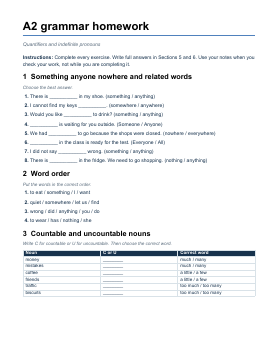
Después de esta clase, Alianna envió A2_Quantifiers_Indefinite_Pronouns_Homework.docx.pdf a las 14:43. El original de tres páginas y su extracción de texto se conservan en los artefactos. Sus ocho secciones están digitalizadas en la tarea de cuantificadores y pronombres indefinidos, sin respuestas añadidas.
Used to refer to two or more people or things previously mentioned or easily identified.
En tu lección
From your lesson: “We made made them for them.”
Otro ejemplo
They are going to the park.
Used to refer to a thing, animal, or idea previously mentioned or easily identified.
En tu lección
From your lesson: “Please show it to her.”
Otro ejemplo
I found a wallet and returned it to the owner.
In or to no place; not in any place.
En tu lección
From your lesson: “We went nowhere last weekend.”
Otro ejemplo
I looked for my keys, but they were nowhere to be found.
Every person; all people considered as a group.
En tu lección
From your lesson: “Everyone was tired after the trip.”
Otro ejemplo
Everyone is invited to the party.
A place or location that is peaceful and free from noise or disturbance.
En tu lección
From your lesson: “I need somewhere quiet to study.”
Otro ejemplo
I need to find somewhere quiet to study for my exams.
An expression used to indicate that the quantity or number of something exceeds what is desirable, acceptable, or manageable.
En tu lección
From your lesson: “There are too many people in this room.”
Otro ejemplo
There are too many people in the room.
Filled with so many people or things that there is little or no space left.
En tu lección
From your lesson: “It feels crowded.”
Otro ejemplo
The bus was so crowded that I could hardly move.
Having a moderately high temperature; not cold or hot.
En tu lección
From your lesson: “Is the soup warm?”
Otro ejemplo
The soup is still warm, so be careful.
Used to refer to the majority of a particular group or thing.
En tu lección
From your lesson: “Most people use phones every day.”
Otro ejemplo
Most children enjoy playing outside.
Facts or details about a person, event, thing, or situation that are communicated or received.
En tu lección
From your lesson: “Most information online is useful.”
Otro ejemplo
The website provides information about local events.
Used in questions or negative statements to mean 'something' or 'a thing' at all.
En tu lección
From your lesson: “Would you like something to eat? Anything?”
Otro ejemplo
Did you see anything unusual last night?
A digital collection of data or information stored on a computer, usually with a specific name and format.
En tu lección
From your lesson: “He sent the files.”
Otro ejemplo
I saved the document as a PDF file.
Las cifras de esta clase, comparadas con todas tus lecciones.
Vocabulario acumulado
1.994 palabras +18 respecto de la clase anterior
Palabras nuevas
18 palabras −7 respecto de la clase anterior
Palabras habladas
618 palabras −292 respecto de la clase anterior
Variedad de vocabulario
15 puntos +1 respecto de la clase anterior
Ritmo al hablar
57 palabras/min
Tiempo hablando
19 min −6 respecto de la clase anterior
41% del tiempo de conversación
Los comentarios y ejemplos están en inglés estadounidense. Próximamente añadiremos más variantes.
Information information.
Tu pronunciación · 0,9 s
Pronunciación de ejemplo · 1,1 s
... your mother.
Tu pronunciación · 0,6 s
Pronunciación de ejemplo · 0,8 s
... you drink?
Tu pronunciación · 0,5 s
Pronunciación de ejemplo · 0,8 s
... with pronouns.
Tu pronunciación · 1,1 s
Pronunciación de ejemplo · 1 s
Dijiste
...Most information online is useful.
Fantastic use of determiners! You're effectively generalizing about information.
Dijiste
...We went nowhere last weekend.
Great job with adverbs! Your sentences are becoming more descriptive and precise.
Dijiste
...We made the sandwich for our friends.
Excellent use of prepositions! You're clearly communicating relationships between words.
Dijiste
...They invited most of us.
Excellent use of pronouns! You're clearly referring to the group.
Dijiste
...There are enough people in this room.
Fantastic use of determiners! You're accurately quantifying nouns.
Dijiste
...I'm I am try finish, the last homework that I start with you.
Una alternativa
I'm trying to finish the last homework I started with you.
Fixed verb form ("try" → "trying") and past tense ("start" → "started"); removed extra words for clarity.
Dijiste
...Most people use phone every day.
Una alternativa
Most people use their phones every day.
Added the possessive determiner "their" and pluralized "phone" to match "most people."
Dijiste...I am not prepared.
ProbáI am not ready.
Has utilizado la palabra 'prepared' en esta frase. ¡Considera la posibilidad de utilizar el término 'ready' para enriquecer tu vocabulario!
Dijiste...There are enough people in this room.
ProbáThere are sufficient people in this room.
Has utilizado la palabra 'enough' en esta frase. ¡Considera la posibilidad de utilizar el término 'sufficient' para enriquecer tu vocabulario!
Dijiste...This is The most interesting pill here?
ProbáThis is the most fascinating pill here?
Has utilizado la palabra 'interesting' en esta frase. ¡Considera la posibilidad de utilizar el término 'fascinating' para enriquecer tu vocabulario!
Respuesta
I gave it to him.
Respuesta
Show it to her.
Respuesta
There are too many people in this room.
Respuesta
Can I have some water?
Respuesta
I’m trying to finish my homework.
Respuesta
Most people use their phones every day.
Respuesta
crowded
Respuesta
information
8 tarjetas para escribir en inglés, letra por letra.
16 tarjetas con audio.