 Abrir en Preply
Giving and showing objects
- Practiced sentences like 'I bought my aunt a scarf' and 'Show me the photo'
- Corrected word order: 'Send it to us' rather than 'Send us it'
Práctica oral de objetos directos e indirectos con give, show, send, buy y make. Se trabajó el orden persona + cosa y cosa + to/for + persona en pedidos, ofrecimientos y situaciones cotidianas.
Practicing object sentences
Con Alianna J.
In this lesson you practised sentences with indirect and direct objects (giving, showing, making) using short examples. The tutor corrected word order and helped you use correct verbs with people and things while you built speaking fluency.
Many verbs take an indirect person object plus a direct thing object, either as person + thing or thing + to/for + person. Use to for transfer and for for benefit. Ejemplos
Correcciones, pronunciación y práctica preparadas a partir de esta clase. No las escribió tu profesora.
El chat documenta give a lift, give them a ride y fragmentos sobre el uso de un cepillo. Se prioriza give someone a ride en inglés estadounidense. Preply señaló offer, quiet, friend y question para pronunciación; sus puntuaciones son indicadores automáticos, no una evaluación de dominio.
Propuesta del asistente, no tarea atribuida a la profesora: pedir el menú, pedir que expliquen una pregunta y ofrecer llevar a alguien en auto. Decir cada frase en voz alta y cambiar el destinatario entre me, us y them.
Alianna envió las tareas el 13 de octubre a las 17:39 y 17:42 (Europe/Vienna). Los cuatro PDFs originales están archivados con sus sumas SHA-256 y texto extraído; se revisaron visualmente sus 50 páginas.
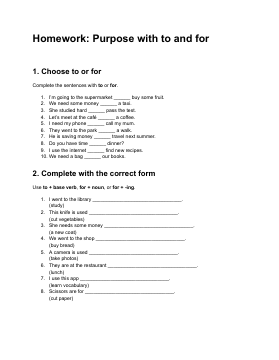
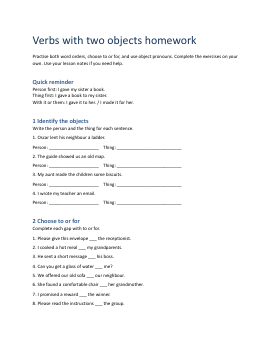
homework/purpose-to-and-for.json.homework/verbs-with-two-objects.json.Los dos formularios copian las consignas y variantes del original, sin respuestas de la estudiante ni soluciones añadidas. Las presentaciones de clase no se convierten en nuevas tareas. En el formulario de propósito, los seis renglones finales quedan como espacios abiertos; en el de objetos se mantienen los subapartados A y B de la sección 3.
A device used to put electrical energy into a battery, such as for a phone, laptop, or other electronic device.
En tu lección
From your lesson: “Please lend your charger to bed.”
Otro ejemplo
I forgot my phone charger at home.
A description of imaginary or real events told for entertainment, information, or instruction (such as in books, movies, or oral tradition).
En tu lección
From your lesson: “I read a history no. Story. A story to my little sister.”
Otro ejemplo
She read a story to the children before bed.
A picture or image made with a pencil, pen, or crayon rather than paint, usually on paper.
En tu lección
From your lesson: “She show the her the hair wrong drawing.”
Otro ejemplo
She showed me her drawing of a cat.
Two or more slices of bread with a filling such as meat, cheese, or vegetables between them, eaten as a meal or snack.
En tu lección
From your lesson: “They bought us some sandwich.”
Otro ejemplo
I had a ham sandwich for lunch.
A person who receives or entertains guests at home or elsewhere.
En tu lección
From your lesson: “We sent a thank you card for hours host two.”
Otro ejemplo
The host greeted everyone at the door.
A covering for the head, usually having a shaped crown and brim, worn for warmth, fashion, or protection.
En tu lección
From your lesson: “She bought a hat to him.”
Otro ejemplo
She wore a red hat to the party.
A special price or deal available for a limited time, often used in advertising or sales.
En tu lección
From your lesson: “The hotel free free breakfast offer.”
Otro ejemplo
This store has a special offer on shoes this week.
A vehicle with two wheels that a person rides by pushing on foot pedals.
En tu lección
From your lesson: “He bought he bought a bicyclid bicycle to no.”
Otro ejemplo
She learned to ride a bicycle when she was six.
Not busy or having little business or traffic.
En tu lección
From your lesson: “I found us quiet table.”
Otro ejemplo
The restaurant was quiet on Monday night.
A suggested plan or offer, especially in business or negotiations.
En tu lección
From your lesson: “I gave proposition I gave a leave my neighborhood.”
Otro ejemplo
He made a business proposition to his partner.
A written or spoken request to someone, asking them to go somewhere or do something.
En tu lección
From your lesson: “She sent to me a invitation.”
Otro ejemplo
She sent me an invitation to her birthday party.
To make something clear or easy to understand by describing or giving information about it.
En tu lección
From your lesson: “Please explain me the question.”
Otro ejemplo
Can you explain the rules to me?
To a small degree; by a small amount.
En tu lección
From your lesson: “Is it the meaning change? Okay. Slightly.”
Otro ejemplo
The soup was slightly too salty for my taste.
A piece of fabric worn around the neck, head, or shoulders for warmth, sun protection, cleanliness, fashion, or religious reasons.
En tu lección
From your lesson: “I bought a scarf for my aunt.”
Otro ejemplo
She wore a red scarf to keep warm in the winter.
A written, printed, or digital paper that provides information or evidence, often official or formal in nature.
En tu lección
From your lesson: “Bring the document to Zara.”
Otro ejemplo
Please sign the document before submitting it.
Las cifras de esta clase, comparadas con todas tus lecciones.
Vocabulario acumulado
1.951 palabras +23 respecto de la clase anterior
Palabras nuevas
23 palabras +3 respecto de la clase anterior
Palabras habladas
657 palabras −31 respecto de la clase anterior
Variedad de vocabulario
15 puntos −2 respecto de la clase anterior
Ritmo al hablar
60 palabras/min −15 respecto de la clase anterior
Tiempo hablando
18 min −8 respecto de la clase anterior
43% del tiempo de conversación
Los comentarios y ejemplos están en inglés estadounidense. Próximamente añadiremos más variantes.
... to offer it.
Tu pronunciación · 0,4 s
Pronunciación de ejemplo · 0,7 s
... a quiet table.
Tu pronunciación · 0,5 s
Pronunciación de ejemplo · 0,9 s
... a friend lunch.
Tu pronunciación · 0,3 s
Pronunciación de ejemplo · 0,8 s
... the question.
Tu pronunciación · 0,6 s
Pronunciación de ejemplo · 0,9 s
Dijiste
...I found us a quiet table.
Well done using the objective pronoun 'us'! Your grammar is consistently good.
Dijiste
...Bring the document to Zara.
Well done using the preposition 'to' to indicate direction! Keep practicing.
Dijiste
...I bought my aunt a scarf.
Excellent use of the indefinite article! Keep up the great work.
Dijiste
...Please show the photo to your parent.
Great job with the singular noun 'parent'! Your attention to detail is impressive.
Dijiste
...Jaime made a list for his sister.
Fantastic use of the preposition 'for' to indicate the beneficiary! You're on your way to fluency.
Dijiste
...She show it her draw drawing.
Una alternativa
She showed her drawing.
Corrected tense and removed extra/misplaced pronouns to make the sentence clear and grammatical.
Dijiste
...She show the hair wrong drawing.
Una alternativa
She showed the wrong hair in the drawing.
Changed verb tense and reordered words so the modifier "wrong" correctly describes "hair" in the drawing.
Dijiste
...His friends He's a friend lunch.
Una alternativa
He's having lunch with his friends.
Reordered fragments and clarified subject; combined into a single natural present progressive sentence.
Dijiste
...Is that really not so more difficult.
Una alternativa
Is that really not much more difficult?
Replaced "so more" with the natural quantifier "much more" and smoothed word order.
Dijiste
...The hotel free breakfast offer.
Una alternativa
The hotel offers free breakfast.
Added the verb "offers" and reordered words to form a complete, natural sentence.
Dijiste...He cooked lunch for his friend.
ProbáHe prepared lunch for his friend.
Has utilizado la palabra 'cooked' en esta frase. ¡Considera la posibilidad de utilizar el término 'prepared' para enriquecer tu vocabulario!
Dijiste...Can you find a seat for me?
ProbáCan you locate a seat for me?
Has utilizado la palabra 'find' en esta frase. ¡Considera la posibilidad de utilizar el término 'locate' para enriquecer tu vocabulario!
Dijiste...Bring the document to Zara.
ProbáDeliver the document to Zara.
Has utilizado la palabra 'bring' en esta frase. ¡Considera la posibilidad de utilizar el término 'deliver' para enriquecer tu vocabulario!
Respuesta
Send it to us.
Respuesta
Please pass me the menu.
Respuesta
The hotel offers free breakfast.
Respuesta
Can you give them a ride?
Respuesta
Please explain the question to me.
Respuesta
story
Respuesta
She sent me an invitation.
Respuesta
Can we have a quiet table?
8 tarjetas para escribir en inglés, letra por letra.
16 tarjetas con audio.