 Abrir en Preply
Using 'to' and 'for' with verbs
- Practiced sentences like 'I went to the shop to buy bread' and 'I need money to take a taxi'
- Corrected examples: 'This knife is used to cut vegetables' and 'Scissors are for cutting paper'
Se practicó cómo expresar propósito con to y for y cómo contar lo que otra persona dijo. La profesora trabajó el orden de las palabras, las formas verbales y frases de la vida cotidiana.
Practicing 'to' and reported speech
Con Alianna J.
In this lesson you practiced using 'to' and 'for' with verbs and objects, and worked on converting direct speech into reported speech. The tutor corrected word order and verb forms while you practiced sentences and short roleplay-style exchanges.
In reported speech, use said/told with an appropriate object, often backshift tenses and modals, and change pronouns and time expressions to fit the new context. Ejemplos
Use to + base verb for an action’s purpose; use for + noun or gerund, especially after expressions such as be used for. Ejemplos
Correcciones, pronunciación y práctica preparadas a partir de esta clase. No las escribió tu profesora.
El chat registra «Tom said (that) he was hungry» y «Laura said she needed my phone». Said puede introducir la información; told necesita destinatario: «My parents told me that they were watching a film». Los cambios de pronombres, tiempo y lugar dependen del contexto; no deben aplicarse mecánicamente. Could lleva verbo base: could meet, no could met.
Esta ampliación conserva lo trabajado con Alianna; no se incorpora como requisito del nivel A1 ni demuestra un avance de nivel. La semana 8 del plan prioriza acciones del momento.
Preply señaló waiter, brother, improve y studying; se conservaron ocho clips de estudiante y referencia. Practicar la k muda de knife y el acento de improve. Las puntuaciones automáticas son orientativas.
Práctica sugerida por el asistente, no tarea atribuida a la profesora: explicar para qué estudiás inglés, para qué necesitás dinero y para qué sirve una bolsa. Después describir qué están haciendo dos personas: «They are watching a movie».
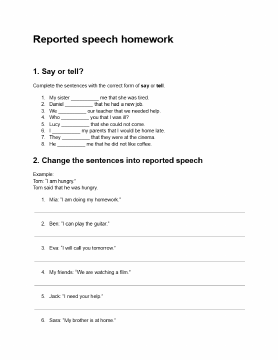
Alianna envió Reported speech homework el 15/10/2026 a las 10:35 (Europe/Vienna), en el mensaje 1270265793. Se archiva aquí por continuidad del tema trabajado el 14/10 y por recibirse antes de la clase del 15/10; el mensaje de adjunto no identifica explícitamente una lección.
El PDF original tiene cuatro páginas, revisadas visualmente. Se digitalizaron sus 34 ejercicios en homework/reported-speech.json: say/tell, transformación a estilo indirecto, opción múltiple, corrección de errores, pronombres y expresiones temporales, y cuatro oraciones personales. Se preservan las consignas y ejemplos impresos sin añadir soluciones. La transcripción se identifica como reconstrucción visual porque el original solo contiene imágenes.
Los materiales sobre propósito con to/for enviados el 13/10 permanecen en la lección anterior.
A tool or utensil with a sharp blade used for cutting, typically consisting of a handle and a blade.
En tu lección
From your lesson: “This knife is used to cut vegetables.”
Otro ejemplo
She used a knife to chop the vegetables.
A device used to take photographs or record videos by capturing images.
En tu lección
From your lesson: “Camera is used for taking photos.”
Otro ejemplo
She bought a new camera for her vacation.
A person whose job is to serve food and drinks to customers at tables in a restaurant or café.
En tu lección
From your lesson: “I told the waiter that the soup was cold.”
Otro ejemplo
The waiter brought us the menu.
The reason for which something is done or created, or for which something exists.
En tu lección
From your lesson: “The first homework purpose with two one four.”
Otro ejemplo
The purpose of this meeting is to discuss the new project.
A set of instructions for preparing a particular dish, including a list of the ingredients required.
En tu lección
From your lesson: “I use the in Internet to find new new recipe recipes.”
Otro ejemplo
I found a great recipe for chocolate cake online.
To remove dirt, dust, or unwanted substances from something, making it free from impurities.
En tu lección
From your lesson: “This tool is used for cleaning shoes.”
Otro ejemplo
I need to clean the kitchen before our guests arrive.
A building or group of buildings where goods are manufactured or assembled, usually in large quantities, using machines.
En tu lección
From your lesson: “She say that she worked worked worked in a factory.”
Otro ejemplo
The factory produces thousands of cars every year.
Feeling a need to rest or sleep due to physical or mental exertion.
En tu lección
From your lesson: “She told me she was tired.”
Otro ejemplo
She felt tired after running the marathon.
Schoolwork assigned to students to be completed outside of class, usually at home.
En tu lección
From your lesson: “I will finish my homework tomorrow.”
Otro ejemplo
I have a lot of homework to do tonight.
A general term for any notebook-style computer, as opposed to a desktop or tablet.
En tu lección
From your lesson: “David said that you can use my laptop.”
Otro ejemplo
Laptops are more convenient for travel than desktops.
The activity or sport of moving through water by using the arms, legs, or body.
En tu lección
From your lesson: “We went to the beach for a swimming for swim.”
Otro ejemplo
Swimming is my favorite way to exercise.
A picture made using a camera, especially one printed on paper or stored digitally.
En tu lección
From your lesson: “This book is for keep keeping all photos.”
Otro ejemplo
She took a photo of the sunset.
Las cifras de esta clase, comparadas con todas tus lecciones.
Vocabulario acumulado
1.976 palabras +25 respecto de la clase anterior
Palabras nuevas
25 palabras +2 respecto de la clase anterior
Palabras habladas
910 palabras +253 respecto de la clase anterior
Variedad de vocabulario
14 puntos −1 respecto de la clase anterior
Ritmo al hablar
57 palabras/min −3 respecto de la clase anterior
Tiempo hablando
25 min +7 respecto de la clase anterior
53% del tiempo de conversación
Los comentarios y ejemplos están en inglés estadounidense. Próximamente añadiremos más variantes.
... the waiter that ...
Tu pronunciación · 0,9 s
Pronunciación de ejemplo · 0,8 s
My brother told ...
Tu pronunciación · 0,7 s
Pronunciación de ejemplo · 0,8 s
... to improve her ...
Tu pronunciación · 1 s
Pronunciación de ejemplo · 1 s
She's studying to ...
Tu pronunciación · 0,8 s
Pronunciación de ejemplo · 0,9 s
Dijiste
...I use this app for learning vocabulary.
Fantastic use of 'for' with a gerund to describe the app's purpose!
Dijiste
...They are at the restaurant for lunch.
Excellent! You're using 'for' correctly to state the reason they are at the restaurant.
Dijiste
...I told the waiter that the soup was cold.
Excellent use of 'that' to introduce a reported speech clause! You're mastering complex sentences.
Dijiste
...They are watching a film.
Fantastic use of the present continuous tense! You're describing ongoing actions perfectly.
Dijiste
...Tom said that he was hungry.
Great job using 'that' to introduce reported speech! Your communication is clear and precise.
Dijiste
... Camera is used for taking photos.
Una alternativa
A camera is used for taking photos.
Added the missing article "A" to make the noun phrase correct.
Dijiste
... Told you that they would not come.
Una alternativa
I told you that they would not come.
Added the missing subject "I" to make the sentence complete.
Dijiste
...She say that she worked in a factory.
Una alternativa
She said that she worked in a factory.
Changed "say" to the past form "said" to match reported speech.
Dijiste
...This book is for keeping all photos.
Una alternativa
This book is for keeping all the photos.
Added the definite article "the" for natural phrasing when referring to a specific collection of photos.
Dijiste
...Anna could met her today here.
Una alternativa
Anna could meet her here today.
Corrected the verb form ("met" → "meet") and moved "here today" to a natural position.
Dijiste...I went to the library to study.
ProbáI visited the library to study.
Has utilizado la palabra 'went' en esta frase. ¡Considera la posibilidad de utilizar el término 'visited' para enriquecer tu vocabulario!
Dijiste...She needs some money for a new coat.
ProbáShe requires some money for a new coat.
Has utilizado la palabra 'needs' en esta frase. ¡Considera la posibilidad de utilizar el término 'requires' para enriquecer tu vocabulario!
Dijiste...I called my friend to ask a question.
ProbáI contacted my friend to ask a question.
Has utilizado la palabra 'called' en esta frase. ¡Considera la posibilidad de utilizar el término 'contacted' para enriquecer tu vocabulario!
Respuesta
She studies to improve her English.
Respuesta
She needs some money for a new coat.
Respuesta
Scissors are for cutting paper.
Respuesta
They are watching a film now.
Respuesta
waiter
Respuesta
knife
6 tarjetas para escribir en inglés, letra por letra.
12 tarjetas con audio.