 Abrir en Preply
Expressing stopped actions
- Practiced sentences with 'I no longer...' and 'do you no longer...?'
- Corrected word order: 'She no longer lives here' not 'She live no longer'
- Replaced incorrect negatives with 'I don't... anymore' when needed
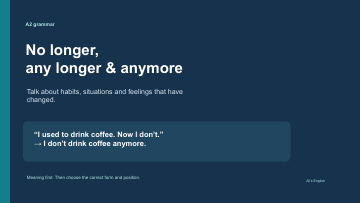
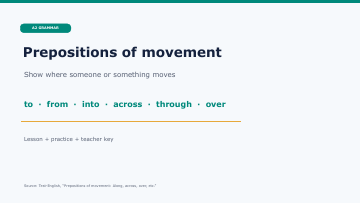
La clase practicó cómo describir cambios entre el pasado y el presente con no longer, any longer y anymore. Se comparó anymore (ya no) con any more (cantidad adicional). También se repasaron verbos de movimiento en pasado y preposiciones como to, from, toward y out of. El material incluye tres PDFs: una hoja de tarea sobre las expresiones de cambio, diapositivas de ese tema y diapositivas de preposiciones de movimiento. La profesora escribió que no terminaron las preposiciones y que todavía no asignaría tarea para ese tema.
Using 'no longer' and 'anymore'
Con Alianna J.
In this lesson you practiced saying things that have stopped (using 'no longer' and 'anymore') and reviewed simple past movement verbs. The tutor corrected sentence order and negatives and you practiced short spoken examples to build accuracy and fluency.
“No longer” usually appears before the main verb; “anymore” and “any longer” commonly appear in negative sentences and questions, usually at the end. Ejemplos
Use the past simple for completed actions in the past; regular verbs often take -ed, while irregular verbs have special forms. Ejemplos
Use movement prepositions to show origin, destination, direction, entry, or exit: from, to, toward, into, and out of. Ejemplos
Correcciones, pronunciación y práctica preparadas a partir de esta clase. No las escribió tu profesora.
La captura conserva doce mensajes de la conversación y cuatro clips de pronunciación, junto con sus referencias de origen. La plataforma registró 721 palabras, 26 palabras nuevas, velocidad de 63 palabras por minuto y 19 minutos de habla de la estudiante (45 %); son métricas de la plataforma, no una evaluación independiente del nivel.
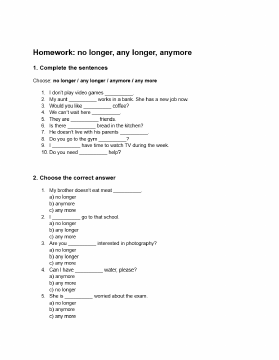
La profesora envió Homework_no_longer_anymore.pdf. Sus tres páginas se revisaron visualmente y se digitalizaron en un formulario, preservando el texto impreso. Las seis respuestas de la sección personal son libres. El PDF escaneado no contiene texto seleccionable; el archivo original se conserva con su checksum y la limitación se anota en la extracción.
Los otros dos PDFs son diapositivas de referencia, no tareas independientes. Se inspeccionaron las 19 páginas de No longer, any longer & anymore (incluidas las dos páginas de respuestas) y las diez páginas de Prepositions of movement. La segunda temática quedó incompleta según la profesora; no se añadió tarea ni se infirió que se hubiera terminado.
Indicating that something that was previously true or happening is not true or happening now.
En tu lección
From your lesson: “She lives no longer here.”
Otro ejemplo
She no longer works at the company.
(Used in negative sentences) At the present time; no longer; from now on.
En tu lección
From your lesson: “I eat chocolate anymore.”
Otro ejemplo
I don't live there anymore.
In the direction of something or someone.
En tu lección
From your lesson: “The children ran towards the sea.”
Otro ejemplo
She walked towards the door.
The place where a person lives, especially with their family; a house or apartment considered as one's residence.
En tu lección
From your lesson: “I walked to home after class.”
Otro ejemplo
After a long day at work, I can't wait to go home.
In the direction of; moving closer to a place, person, or thing.
En tu lección
From your lesson: “The ball rolled toward the window.”
Otro ejemplo
She walked toward the door.
Feeling fear or anxiety about something or someone that may be dangerous, painful, or threatening.
En tu lección
From your lesson: “She is no longer afraid of dogs.”
Otro ejemplo
She is afraid of spiders.
To create, produce, or construct something.
En tu lección
From your lesson: “I no longer made made made cake Italian.”
Otro ejemplo
She likes to make her own clothes.
To go to a website or web page on the internet.
En tu lección
From your lesson: “I no longer visit use USA.”
Otro ejemplo
You should visit our website for more information.
To perceive with the eyes; to notice or become aware of something visually.
En tu lección
From your lesson: “The child ran tall her mother when she saw her.”
Otro ejemplo
I see a bird in the tree.
To operate and control the movement of a vehicle, such as a car or truck.
En tu lección
From your lesson: “We drove to the airport at 5AM.”
Otro ejemplo
I learned to drive when I was sixteen.
To remove or extract something from a place or group.
En tu lección
From your lesson: “She took her phone out of her pocket.”
Otro ejemplo
Please take your shoes off before entering.
Las cifras de esta clase, comparadas con todas tus lecciones.
Vocabulario acumulado
2.020 palabras +26 respecto de la clase anterior
Palabras nuevas
26 palabras +8 respecto de la clase anterior
Palabras habladas
721 palabras +103 respecto de la clase anterior
Variedad de vocabulario
17 puntos +2 respecto de la clase anterior
Ritmo al hablar
63 palabras/min +6 respecto de la clase anterior
Tiempo hablando
19 min
45% del tiempo de conversación
Los comentarios y ejemplos están en inglés estadounidense. Próximamente añadiremos más variantes.
My brother doesn't live ...
Tu pronunciación · 0,7 s
Pronunciación de ejemplo · 0,8 s
The child run ...
Tu pronunciación · 0,8 s
Pronunciación de ejemplo · 0,9 s
... no longer afraid ...
Tu pronunciación · 0,7 s
Pronunciación de ejemplo · 0,8 s
... eat chocolate anymore.
Tu pronunciación · 1,1 s
Pronunciación de ejemplo · 0,9 s
Dijiste
...We walked to the cafe.
Excellent use of the simple past tense! You're clearly describing a completed action. Keep up the great work!
Dijiste
...I walked home after class.
Fantastic! Your use of the simple past tense is perfect for describing a past event. You're doing wonderfully!
Dijiste
...He want to see.
Una alternativa
He wants to see.
Corrected verb to agree with the singular subject (he → wants).
Dijiste
...I don't eat eating.
Una alternativa
I'm not eating.
Replaced the incorrect verb phrase with the natural present continuous form.
Dijiste
...The child run her mom when she saw her.
Una alternativa
The child ran to her mom when she saw her.
Changed verb to past tense and added preposition "to" to show direction.
Dijiste
...She live here.
Una alternativa
She lives here.
Added -s to agree with singular subject (she → lives).
Dijiste
...The ball rolled from the window.
Una alternativa
The ball rolled out of the window.
Changed preposition for natural description of something leaving through a window.
Dijiste...Does he no longer live in London?
ProbáDoes he not live in London anymore?
Has utilizado la palabra 'no longer' en esta frase. ¡Considera la posibilidad de utilizar el término 'not anymore' para enriquecer tu vocabulario!
Dijiste...Do you work there any longer?
ProbáDo you work there anymore?
Has utilizado la palabra 'any longer' en esta frase. ¡Considera la posibilidad de utilizar el término 'anymore' para enriquecer tu vocabulario!
Respuesta
She no longer lives here.
Respuesta
I don’t watch TV anymore.
Respuesta
Do you work there any longer?
Respuesta
Do you want any more cake?
Respuesta
I no longer live there.
Respuesta
We are no longer neighbours.
Respuesta
She took her phone out of her pocket.
Respuesta
toward
8 tarjetas para escribir en inglés, letra por letra.
16 tarjetas con audio.