 Abrir en Preply
Using in time / on time / just in time
- Practiced differences between 'in time' and 'on time' with examples
- Used 'just in time' in sentences about trains, flights, and meetings
Timing and 'in time' vs 'on time'
Con Alianna J.
In this lesson you practiced using time expressions (in time, on time, just in time, at the end) and recounting short events. The tutor corrected word choice, pronunciation, and small grammar issues while you practiced example sentences and short dialogues.
Use “on time” for punctuality, “in time” for being early enough, “at the end” for the final point of something, and “in the end” for the final result. Ejemplos
Correcciones, pronunciación y práctica preparadas a partir de esta clase. No las escribió tu profesora.
La clase practicó expresiones de tiempo y relatos breves. El foco fue distinguir on time (a la hora prevista) de in time (con tiempo suficiente), además de usar just in time, at the end e in the end. También se repasaron vocabulario y pronunciación en ejemplos sobre trenes, reuniones, libros y otras situaciones cotidianas.
on time: puntual, a la hora acordada. The train arrived on time.in time (for + sustantivo / to + verbo): con tiempo suficiente para algo. We arrived in time for the meeting. / My friends arrived just in time to take the train.at the end of + sustantivo: en el punto final de algo. At the end of the book, the main character goes home.in the end: finalmente, como resultado. In the end, my friends arrived just in time to take the train.My alarm went off, so I got to work in time for the meeting.I finished the report just in time for my boss to read it before lunch.the submission; posesivo y plural en the book's main characters.El feedback de Preply también destacó el uso correcto de presente simple y pasado simple en ejemplos narrativos. Las sugerencias automáticas se conservaron como evidencia; las notas de Anki usan formas naturales revisadas.
Vocabulario observado incluye tiring, detective, character, deadline, discussion, conference y resolution, además de las expresiones de tiempo de la clase. Los clips de pronunciación disponibles corresponden a character, deadline, birthday y cheaper.
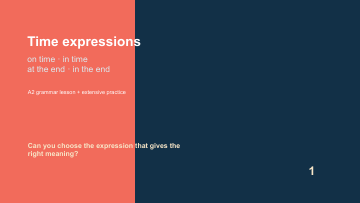
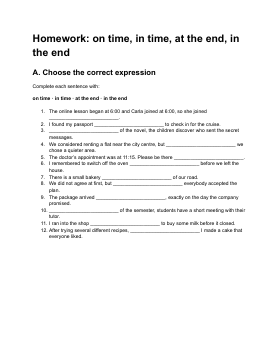
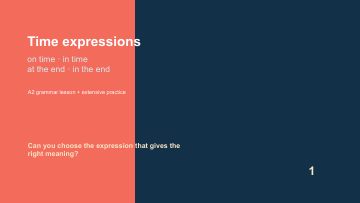
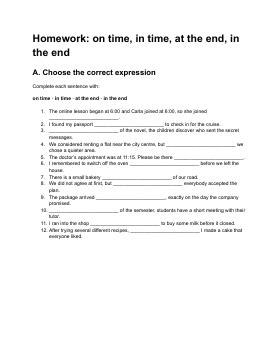
Homework__on_time__in_time__at_the_end__in_the_end.pdf y las diapositivas Time_Expressions_A2.pdf.artifacts/source-original/ y artifacts/source-manifest.json, dentro del archivo privado.Se revisaron visualmente las 17 páginas de las diapositivas y las 4 páginas de la tarea agregadas al cerrar la ventana de la clase. El formulario existente ya coincide con los 29 ejercicios de las secciones A–D (12, 6, 6 y 5); no requiere cambios ni una segunda copia. La tarea pide elegir expresiones, reformular, corregir y escribir cinco oraciones propias. Las diapositivas quedan como PDF de apoyo, con práctica oral por parejas; no se convierten en otro formulario. La revisión no demuestra que Celeste haya completado esos ejercicios.
La paginación impresa 4/5 de las diapositivas está invertida respecto del orden físico del PDF. En la página física 5, el ejercicio del autobús dice que llegó tarde pero pide compararlo con el horario: es contradictorio. Las frases con plazos o fiestas pueden admitir on time o in time según si se destaca el horario o el tiempo suficiente; la clave no determina por sí sola la única respuesta natural. Las seis tarjetas existentes ya cubren los patrones relevantes y se conservan sin copiar ejercicios del PDF ni sumar duplicados. El nivel configurado es A1; el repaso usa explicaciones breves aunque el material esté rotulado A2.
Causing someone to feel tired; making someone lose energy or feel the need to rest.
En tu lección
From your lesson: “It's it's very, very long. It's very, very tired. Tiring.”
Otro ejemplo
The long walk was very tiring.
Before a deadline or before something happens; early enough to do something or to avoid being late.
En tu lección
From your lesson: “My my alarm worked, so I go to work in time for the minute the meeting.”
Otro ejemplo
She arrived in time to catch the beginning of the movie.
At the scheduled or expected time; not late.
En tu lección
From your lesson: “The 08:15 train usually leaves just in time Oh, just in time. It doesn't no headset is on time.”
Otro ejemplo
The train arrived on time despite the heavy rain.
Ultimately; after everything has been considered or after all events have occurred.
En tu lección
From your lesson: “The weather look looked bad, but in the end, it was sunny all day.”
Otro ejemplo
In the end, we decided to cancel the trip due to bad weather.
Indicating the final point or conclusion of a process, event, or period of time.
En tu lección
From your lesson: “At the end at the end of the book, the main character goes home.”
Otro ejemplo
At the end of the movie, the hero saves the day.
A person, especially a police officer, whose job is to investigate and solve crimes.
En tu lección
From your lesson: “I don't know if it comes in pronunciation. Detective. A detective finds the missing ring in the end.”
Otro ejemplo
The detective questioned all the witnesses at the scene.
A symbol, letter, or sign used in writing or printing.
En tu lección
From your lesson: “The the book main chart charters. How how come is it? Chart comma? Character.”
Otro ejemplo
Type your password using at least one special character.
A greater liking for one alternative over another or others.
En tu lección
From your lesson: “The preference is perfect.”
Otro ejemplo
She has a preference for tea over coffee.
To elaborate on something by providing more detail or information.
En tu lección
From your lesson: “Expand case.”
Otro ejemplo
Could you expand on your last point?
An event where people gather to exchange information, ideas, or opinions, often including lectures, presentations, and workshops.
En tu lección
From your lesson: “The conference begins at night.”
Otro ejemplo
The conference included several workshops on technology.
A specific time or date by which something must be finished or submitted.
En tu lección
From your lesson: “The deadline was midnight.”
Otro ejemplo
The project deadline is next Friday.
A conversation or talk between two or more people about a particular topic, often to exchange ideas or opinions.
En tu lección
From your lesson: “After a long discussion, the team chose free day.”
Otro ejemplo
We had a discussion about the new project.
The process of making an image, screen, or device clear and detailed, especially in terms of the number of pixels or lines.
En tu lección
From your lesson: “The time resolution.”
Otro ejemplo
The camera has a high resolution for better pictures.
A long, ancient Greek epic poem attributed to Homer, describing the adventures of Odysseus as he returns home from the Trojan War.
En tu lección
From your lesson: “Odyssey.”
Otro ejemplo
Odyssey is one of the most famous works of ancient literature.
Las cifras de esta clase, comparadas con todas tus lecciones.
Vocabulario acumulado
2.056 palabras +36 respecto de la clase anterior
Palabras nuevas
36 palabras +10 respecto de la clase anterior
Palabras habladas
844 palabras +123 respecto de la clase anterior
Variedad de vocabulario
14 puntos −3 respecto de la clase anterior
Ritmo al hablar
72 palabras/min +9 respecto de la clase anterior
Tiempo hablando
22 min +3 respecto de la clase anterior
48% del tiempo de conversación
Los comentarios y ejemplos están en inglés estadounidense. Próximamente añadiremos más variantes.
Character.
Tu pronunciación · 0,9 s
Pronunciación de ejemplo · 0,9 s
... tid deadline was ...
Tu pronunciación · 1,1 s
Pronunciación de ejemplo · 0,9 s
... pre birthday present ...
Tu pronunciación · 1,1 s
Pronunciación de ejemplo · 1 s
... the cheaper one.
Tu pronunciación · 0,5 s
Pronunciación de ejemplo · 0,8 s
Dijiste
...At the end of the book, the main character goes home.
Great job! The present tense 'goes' is perfectly used here to describe a narrative event. You're doing wonderfully!
Dijiste
...At the end of the match, the player shook hands.
Well done! Your use of the past tense 'shook' is spot on, making your narrative clear and precise. Keep up the fantastic work!
Dijiste
...I go to the theater.
Fantastic! Your use of the simple present tense is perfect for expressing a regular activity. Keep up the great work!
Dijiste
...Our teacher gives us homework.
Excellent! Your use of the simple present tense 'gives' is perfect for a routine action. Keep up the great work!
Dijiste
...The plane left late, but we still arrived.
Fantastic! Your use of the past tense 'left' is perfectly clear and concise. Keep mastering those verb tenses!
Dijiste
...My alarm worked, so I go to work in time for the meeting.
Una alternativa
My alarm went off, so I got to work in time for the meeting.
Corrected tense and more natural verb choice ("went off", "got to") to match past context.
Dijiste
...The bus was late, but it arrived in time for the submitted.
Una alternativa
The bus was late, but it arrived in time for the submission.
Replaced incorrect noun "the submitted" with the correct noun "the submission" to make the phrase meaningful.
Dijiste
...I finished the report just in time for my boss to read before lunch.
Una alternativa
I finished the report just in time for my boss to read it before lunch.
Added the missing object "it" for clarity and grammatical completeness.
Dijiste
...The book main chart charters.
Una alternativa
The book's main characters.
Corrected word order, added possessive "'s", and changed to the plural noun "characters" to form a coherent noun phrase.
Dijiste...Please arrive at the time.
ProbáPlease show up at the time.
Has utilizado la palabra 'arrive' en esta frase. ¡Considera la posibilidad de utilizar el término 'show up' para enriquecer tu vocabulario!
Dijiste...We submitted it on time.
ProbáWe turned it in on time.
Has utilizado la palabra 'submitted' en esta frase. ¡Considera la posibilidad de utilizar el término 'turned in' para enriquecer tu vocabulario!
Dijiste...Can you send the card in time for her birthday?
ProbáCan you dispatch the card in time for her birthday?
Has utilizado la palabra 'send' en esta frase. ¡Considera la posibilidad de utilizar el término 'dispatch' para enriquecer tu vocabulario!
Respuesta
The train arrived on time.
Respuesta
My friends arrived just in time to take the train.
Respuesta
At the end of the book, the main character goes home.
Respuesta
My alarm went off at six.
Respuesta
I finished the report just in time for my boss to read it before lunch.
Respuesta
The main character goes home at the end of the book.
6 tarjetas para escribir en inglés, letra por letra.
12 tarjetas con audio.