 Abrir en Preply
Travel and movement phrases
- Practiced prepositions: on foot, by car, by plane, by train
- Described routes: go past, across, through, over, into
- Narrated short travel events: got off, walked, cycled, drove
Practicing travel and direction phrases
Con Alianna J.
In this lesson you practiced talking about travel, movement and daily routines, and reviewed short responses and agreement phrases. The tutor corrected prepositions of movement and helped you use short answers (so do I, neither do I) and past simple forms in short sentences.
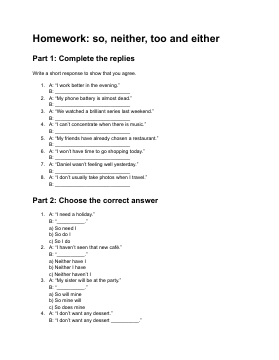
Use “so + auxiliary/modal + subject” to agree with a positive statement, and “neither + auxiliary/modal + subject” to agree with a negative statement. Ejemplos
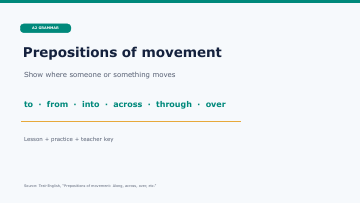
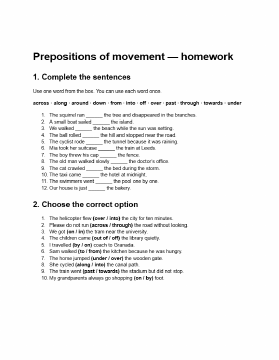
Movement prepositions describe the path or direction of movement: “through” for inside an area, “across” from one side to another, “over” above or across, and “towards” in the direction of something. Ejemplos
Correcciones, pronunciación y práctica preparadas a partir de esta clase. No las escribió tu profesora.
Se trabajaron viajes, medios de transporte y recorridos: by car / by train / by plane, pero on foot; in the car indica estar dentro del vehículo. Para seguir una ruta se practicaron along, past, over, through, across, into y la dirección toward. El chat registra también got off, pasado de get off. En las fuentes aparecen relatos breves con walked, cycled y drove.
El segundo eje fue expresar «yo también / yo tampoco»: so + auxiliar + sujeto y neither + auxiliar + sujeto. En presente: I’m tired. — So am I. / I don’t drive. — Neither do I. Con too / either se conserva el orden normal: I am too. / I don’t either. El auxiliar concuerda con el sujeto de la respuesta, que puede ser otra persona o un grupo.
Las presentaciones incluyen ejercicios guiados de rutas, transporte y respuestas breves; los insights documentan práctica de esos patrones. No se puede afirmar que se completaran todos los ejercicios ni que sus personajes o viajes describan la vida de Celeste.
Preply señala waiter, exhausted, school y el nombre Chloe. Como apoyo estadounidense: waiter /ˈweɪtər/, exhausted /ɪɡˈzɔstɪd/, school /skul/ (sin vocal inicial añadida). Las puntuaciones automáticas no demuestran por sí solas una dificultad concreta; los clips no sustituyen una evaluación completa.
Repaso sugerido, creado a partir de lo practicado: dar tres indicaciones cortas para llegar a una estación, distinguir viajar by car de estar in the car, y responder a una afirmación y una negación con be / do / can. El plan activo corresponde a la semana 10 (26 de octubre al 1 de noviembre), pasado de be; mantener was/were como foco central. Los pasados léxicos y las estructuras con have, will, should de las fuentes quedan como ampliación breve, sin asumir avance de nivel.
homework/prepositions-of-movement.json. Transcripción visual del PDF sin texto seleccionable. El banco de la sección 1 omite una palabra necesaria; algunos contextos admiten varias direcciones y la sección 5.6 ya contiene la palabra pedida. Se conservan los originales y se señalan estas inconsistencias sin añadir soluciones.homework/so-neither-too-either.json. No hay respuestas de Celeste ni soluciones añadidas.Se revisaron visualmente las 45 páginas de los cuatro originales. No está disponible la grabación completa; no se reconstruye una transcripción ni se atribuyen frases de ejercicios a experiencias personales. El chat y los insights no confirman entrega, respuestas, corrección de tareas ni dominio autónomo. Las métricas de Preply son estimaciones de la plataforma, no una evaluación CEFR.
Traveling or being transported using a train as the mode of transportation.
En tu lección
From your lesson: “Eight day travel to Italy by train.”
Otro ejemplo
We decided to go to Paris by train instead of flying.
To move beyond a particular point or place, often by walking, driving, or traveling.
En tu lección
From your lesson: “As I walk along the street, go past the bank, then walk over the bridge.”
Otro ejemplo
We go past the library every day on our way to school.
From one end or side of something to the other; moving in at one side and out at the other.
En tu lección
From your lesson: “Across a tunnel or through?”
Otro ejemplo
She walked through the door.
To leave a vehicle, such as a bus, train, or plane.
En tu lección
From your lesson: “He's back. Got off.”
Otro ejemplo
I get off the bus at the next stop.
A person whose job is to serve food and drinks to customers at tables in a restaurant or café.
En tu lección
From your lesson: “The waiter came across the kitchen into the kitchen.”
Otro ejemplo
The waiter brought us the menu.
Extremely tired; having no energy left due to physical or mental effort.
En tu lección
From your lesson: “I am exhausted.”
Otro ejemplo
After running the marathon, she felt exhausted.
A person who walks long distances in the countryside, mountains, or nature for pleasure or exercise.
En tu lección
From your lesson: “The hikers walked onto the forest.”
Otro ejemplo
The hiker followed the trail through the forest.
A woman whose job is to serve food and drinks to customers at tables in a restaurant, café, or similar establishment.
En tu lección
From your lesson: “The wait waitress waitress Wait.”
Otro ejemplo
The waitress brought us our menus.
A large, slow-moving mass of ice formed from compacted layers of snow, found in cold regions or on mountains.
En tu lección
From your lesson: “Because change hotel. Yes. Glaciers.”
Otro ejemplo
The glacier moved slowly down the mountain.
An underground or underwater passage, typically for vehicles, trains, or pedestrians, that allows travel through or under an obstacle such as a mountain, river, or city.
En tu lección
From your lesson: “He went over a small bridge and across a tunnel.”
Otro ejemplo
The train passed through a long tunnel under the mountain.
A structure built to span and provide passage over a river, road, or other obstacle.
En tu lección
From your lesson: “He went over a small bridge.”
Otro ejemplo
The bridge over the river is very old.
A place in a restaurant, hotel, or other establishment where food is prepared and cooked for customers.
En tu lección
From your lesson: “The waiter came across the kitchen into the kit into the kitchen.”
Otro ejemplo
He works in the kitchen of a busy restaurant.
A person or organization that legally possesses something, such as property, a business, or an object.
En tu lección
From your lesson: “He took it under the owner.”
Otro ejemplo
The owner of the house decided to sell it.
Las cifras de esta clase, comparadas con todas tus lecciones.
Vocabulario acumulado
2.162 palabras +25 respecto de la clase anterior
Palabras nuevas
25 palabras −4 respecto de la clase anterior
Palabras habladas
565 palabras −297 respecto de la clase anterior
Variedad de vocabulario
14 puntos −6 respecto de la clase anterior
Ritmo al hablar
49 palabras/min −17 respecto de la clase anterior
Tiempo hablando
14 min −9 respecto de la clase anterior
40% del tiempo de conversación
Los comentarios y ejemplos están en inglés estadounidense. Próximamente añadiremos más variantes.
The waiter came ...
Tu pronunciación · 0,8 s
Pronunciación de ejemplo · 0,8 s
I'm exhausted exhausted ...
Tu pronunciación · 1,1 s
Pronunciación de ejemplo · 1,1 s
... to Chloe isn't at ...
Tu pronunciación · 0,8 s
Pronunciación de ejemplo · 0,9 s
... to school or ...
Tu pronunciación · 0,4 s
Pronunciación de ejemplo · 0,8 s
Dijiste
...The museum is on your left.
Well done! You used the preposition naturally to describe a location.
Dijiste
...I haven't done my homework.
Well done using the present perfect correctly. Keep practicing with confidence!
Dijiste
...I can speak some French.
Excellent use of “some” with a language. You're making steady progress!
Dijiste
...Hannah, drive past the supermarket.
Nicely done! You used the imperative form correctly to give a direction.
Dijiste
...I don't run across the road.
Great use of a prepositional phrase. Keep building on your clear, natural English!
Dijiste
...The wait didn't came into the kitchen.
Una alternativa
The waiter didn't come into the kitchen.
Use “waiter” for a person serving food, and use the base form “come” after “didn't.”
Dijiste
...The chiller run towards the playground.
Una alternativa
The children ran toward the playground.
“Children” is the likely intended word, and “ran” is the past-tense form needed here.
Dijiste
...My brother's is at university.
Una alternativa
My brother is at university.
Remove the apostrophe and “s”; the possessive form isn’t needed before “is.”
Respuesta
I go by train.
Respuesta
I’m in the car.
Respuesta
On foot.
Respuesta
Go past the bank.
Respuesta
Through.
Respuesta
Across.
Respuesta
Over.
Respuesta
Go into the kitchen.
Respuesta
Toward.
Respuesta
I get off at the next stop.
Respuesta
Got off.
Respuesta
So am I.
Respuesta
So do I.
Respuesta
Neither do I.
Respuesta
I’m not either.
Respuesta
Exhausted.
Respuesta
Waiter.
Respuesta
School.
Respuesta
He is still a little sick.
Respuesta
I didn’t come.
20 tarjetas para escribir en inglés, letra por letra.
40 tarjetas con audio.