 Abrir en Preply
Past habits with 'used to'
- Practiced positive and negative sentences using 'used to' for past routines
- Answered questions with 'Did you use to...?' and corrected word order
- Converted simple past actions into 'used to' for repeated past actions
Se repasaron hábitos pasados con used to, preguntas y negativos con did, combinaciones con make/do y phrasal verbs: turn on/off, look for, pick up y put on. El chat agrega food poisoning, neighbourhood, badly y look forward to. Son fuentes de la clase; no se incorporan como hechos biográficos al perfil.
Practicing 'used to' and verb collocations
Con Alianna J.
In this lesson you practiced past habitual expressions with used to/didn't used to and worked on common verb collocations (make/do, turn on/off, look for). The tutor corrected sentence forms, pronunciation, and helped you replace simple past sentences with 'used to' where appropriate.
Use “used to + base verb” for past habits or states. Use “didn’t use to” for negatives and “Did ... use to?” for questions. Ejemplos
Correcciones, pronunciación y práctica preparadas a partir de esta clase. No las escribió tu profesora.
La semana 8 del plan trabaja presente continuo para describir acciones actuales. Las notas refuerzan ese patrón y lenguaje cotidiano, manteniendo A1 como nivel configurado. Los contenidos A2 asignados por la tutora se conservan sin convertirlos automáticamente en evidencia de dominio.
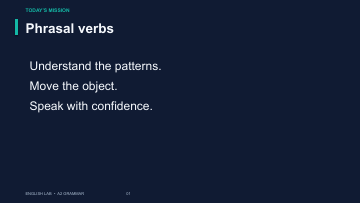
La tutora envió A2_Phrasal_Verbs (PDF de 18 páginas) a las 13:56 y A2_Phrasal_Verbs_Homework.docx a las 13:58. Se revisaron visualmente todas sus páginas y se guardó texto extraído. El PDF de apoyo incluye explicaciones, práctica y claves del docente; se conserva como material de clase.
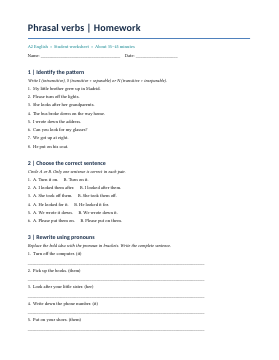
La tarea Word se convirtió localmente en phrasal-verbs-homework-converted-from-docx.pdf, de tres páginas, con procedencia registrada en artifacts/extracted/document-conversions.md. Se conserva el Word original sin cambios.
homework/phrasal-verbs.json contiene 40 ítems en seis secciones: identificar patrones (8), elegir oraciones (6), reescribir con pronombres (6), corregir errores (8), completar (8) y escribir sobre la propia vida (4). Las opciones I/S/N y A/B usan menús; no se agregan soluciones ni respuestas personales. La sección 3 alude a negrita que no se distingue en el original. En 5.2 el único hueco antes de it presenta un problema de posición del pronombre: se conserva y se señala para consultar con la tutora. No se encontró fecha de entrega.
An expression used to indicate a past habit or state that is no longer true or current.
En tu lección
From your lesson: “Did you used to ride a bike to school?”
Otro ejemplo
I used to play the piano when I was a child.
In or to a foreign country or countries.
En tu lección
From your lesson: “Did you grandpas use to travel abroad abroad?”
Otro ejemplo
She studied abroad for a year in France.
Having been damaged and no longer in one piece or working order.
En tu lección
From your lesson: “Broken as broke. Half broken.”
Otro ejemplo
The broken window let in a cold draft.
A message sent electronically from one person to another via a computer network.
En tu lección
From your lesson: “Yesterday, Ben made a mistake in his mail. I am email, comma, email.”
Otro ejemplo
I received an email from my friend this morning.
To wash the plates, cups, and other utensils used during a meal.
En tu lección
From your lesson: “Do the dishes.”
Otro ejemplo
After dinner, I always do the dishes to help out.
To earn money or income to support oneself financially through work or business.
En tu lección
From your lesson: “Make a living.”
Otro ejemplo
She makes a living by teaching English online.
To style, cut, or arrange someone's hair, typically by a hairdresser or a person skilled in hair care.
En tu lección
From your lesson: “Do your hair.”
Otro ejemplo
She went to the salon to have someone do her hair before the party.
To enroll in and attend a series of lessons or classes on a particular subject or skill.
En tu lección
From your lesson: “Do a course.”
Otro ejemplo
I decided to do a course in graphic design to improve my skills.
To deal with or handle a task, problem, or situation.
En tu lección
From your lesson: “Take care of no. Care. Take care of.”
Otro ejemplo
I'll take care of the booking for the conference.
To try to find something or someone by searching or seeking.
En tu lección
From your lesson: “I look look at look at look at look for my wallet.”
Otro ejemplo
I'm looking for my keys; have you seen them?
To stop the operation of a device or machine by switching it off.
En tu lección
From your lesson: “Turn off.”
Otro ejemplo
Please turn off the lights when you leave the room.
To put a harmful or deadly substance into something, especially food or drink, with the intention of causing illness or death.
En tu lección
From your lesson: “But I am sick every day on Saturday. I am what do I call? Mhmm. For because I ate salmon. So I Poison.”
Otro ejemplo
Someone tried to poison the king's wine.
A plant or part of a plant used as food, typically not sweet and eaten as part of a savory meal (such as carrots, potatoes, or spinach).
En tu lección
From your lesson: “And my brother didn't used to like vegetables, but he likes them now.”
Otro ejemplo
Carrot is my favorite vegetable.
An idea, plan, or proposal that someone offers for consideration or action.
En tu lección
From your lesson: “Make a suggestion.”
Otro ejemplo
She made a suggestion to improve the meeting schedule.
A task or piece of work that someone is given to do, often as part of a job or course of study.
En tu lección
From your lesson: “I am doing a assignment s. An assignment.”
Otro ejemplo
The teacher gave us an assignment to write an essay.
A Japanese martial art that uses hand and foot strikes for self-defense and combat.
En tu lección
From your lesson: “My cousins do karate every Tuesday?”
Otro ejemplo
He has been practicing karate for five years.
A physical, mental, and spiritual practice originating from ancient India, involving breath control, meditation, and specific bodily postures.
En tu lección
From your lesson: “Right now, we are doing yoga on Monday.”
Otro ejemplo
She practices yoga every morning to stay healthy.
Las cifras de esta clase, comparadas con todas tus lecciones.
Vocabulario acumulado
1.928 palabras +20 respecto de la clase anterior
Palabras nuevas
20 palabras −14 respecto de la clase anterior
Palabras habladas
688 palabras −176 respecto de la clase anterior
Variedad de vocabulario
17 puntos +3 respecto de la clase anterior
Ritmo al hablar
75 palabras/min +2 respecto de la clase anterior
Tiempo hablando
26 min +5 respecto de la clase anterior
54% del tiempo de conversación
Los comentarios y ejemplos están en inglés estadounidense. Próximamente añadiremos más variantes.
Rest restaurants.
Tu pronunciación · 0,7 s
Pronunciación de ejemplo · 1 s
... to travel abroad ...
Tu pronunciación · 1,1 s
Pronunciación de ejemplo · 1 s
... the homework yesterday?
Tu pronunciación · 0,7 s
Pronunciación de ejemplo · 0,9 s
... my brother didn't used ...
Tu pronunciación · 0,4 s
Pronunciación de ejemplo · 0,8 s
Dijiste
...My cousins do karate every Tuesday.
Great use of the present simple for a regular activity! You're consistently accurate!
Dijiste
...I used to watch cartoons every morning.
Excellent use of 'used to' to describe past habits! Keep up the great work!
Dijiste
...Now we live in the city.
Perfectly clear and concise use of the present simple! You're doing great!
Dijiste
...She used to be scared of dogs.
Fantastic job using 'used to' for past states! Your grammar is really shining!
Dijiste
...He played football every Saturday.
Great use of the simple past for a completed action! You're mastering those tenses!
Dijiste
...Did you used to ride a bike to school.
Una alternativa
Did you use to ride your bike to school?
After "did" use base verb "use"; added "your" for natural phrasing.
Dijiste
...I look for my wallet.
Una alternativa
I'm looking for my wallet.
Changed simple present to present continuous for an action happening now.
Dijiste
...He played football every played.
Una alternativa
He played football every day.
Replaced the incorrect word "played" with "day" to form the time expression.
Dijiste
...Did your grandpas use to travel abroad.
Una alternativa
Did your grandfathers use to travel abroad?
Changed "used" to "use" after "did"; "grandfathers" is more standard than "grandpas."
Dijiste
...I didn't used to like spicy food when I was child.
Una alternativa
I didn't use to like spicy food when I was a child.
Changed "used" to base form "use" after "didn't" and added article "a" before "child."
Dijiste...But I am sick every day on Saturday.
ProbáBut I am unwell every day on Saturday.
Has utilizado la palabra 'sick' en esta frase. ¡Considera la posibilidad de utilizar el término 'unwell' para enriquecer tu vocabulario!
Dijiste...We have arrived at the party.
ProbáWe have reached the party.
Has utilizado la palabra 'arrived' en esta frase. ¡Considera la posibilidad de utilizar el término 'reached' para enriquecer tu vocabulario!
Dijiste...Yesterday, Ben made a mistake in his mail.
ProbáYesterday, Ben made an error in his mail.
Has utilizado la palabra 'mistake' en esta frase. ¡Considera la posibilidad de utilizar el término 'error' para enriquecer tu vocabulario!
Respuesta
I am looking for my phone now.
Respuesta
neighborhood
Respuesta
badly
Respuesta
I am looking forward to the weekend.
Respuesta
Please turn it off.
Respuesta
I want to travel abroad.
Respuesta
My phone is broken.
Respuesta
My brother lives nearby.
8 tarjetas para escribir en inglés, letra por letra.
16 tarjetas con audio.